
The world of hiring and team building is getting a major upgrade. No longer just a buzzword, artificial intelligence is fundamentally changing how companies find, hire, and plan for the talent they need. This shift moves us from gut-feeling decisions to a data-driven strategy, powered by smart technology.
This isn’t a future concept. The market for artificial intelligence in human resources is booming, with one study projecting the global market to grow significantly from a base of $1.17 billion. This growth signals a major shift. Today’s workforce planning isn’t just about filling today’s roles; it’s about predicting tomorrow’s needs. Advanced systems can now predict future skill gaps and talent shortages before they become a business risk.
This management of talent is evolving. AI tools are now used for everything from screening a high volume of resumes with over 95% accuracy in matching candidates to roles, to predicting which employees might be at risk of leaving. This allows for more strategic, forward-thinking workforce planning. It’s about building a resilient, future-ready organization.
Key Takeaways
- AI is a Strategic Partner: Modern AI tools act as a co-pilot for HR, automating routine tasks and surfacing data-driven insights for smarter decisions.
- From Reactive to Predictive: The focus is shifting from filling immediate vacancies to predicting future skill gaps and talent needs before they become critical.
- Data is the New Currency: Decisions are increasingly based on data and predictive analytics, not just intuition, making hiring and planning more objective.
- Efficiency Meets Accuracy: Technologies can screen and match candidates with over 95% accuracy, freeing up human time for strategic management and human connection.
- It’s About Augmentation: The goal is not to replace human decision-making, but to augment it, providing leaders with the insights needed to build a more agile and prepared workforce.
How AI is Redefining Talent Acquisition & Workforce Planning
The era of gut-feel decisions and reactive hiring is rapidly giving way to a new, intelligent approach to talent. This isn’t just about using new tools; it’s a fundamental paradigm shift in how organizations think about their people strategy.
For years, traditional talent management was often reactive. Workforce planning was an annual exercise, a budget-driven headcount forecast. Recruitment was a scramble to fill open seats, often based on gut feeling and a flood of resumes. Performance management was a dreaded, once-a-year event. This reactive model left companies vulnerable to talent shortages and high turnover, as decisions were based more on intuition than insight.
Artificial intelligence is flipping the script. Instead of reacting to vacancies, artificial intelligence enables a proactive, predictive, and deeply personalized approach. It moves the function from a reactive cost center to a strategic partner that drives business value.
This new approach creates an “intelligent talent lifecycle.” Artificial intelligence doesn’t just automate tasks; it connects every stage—from predicting future skill needs and sourcing candidates to personalizing career development paths. This creates a continuous, data-driven loop for the entire employee journey.
This is not a niche experiment. A full 93% of Fortune 500 CHROs are already integrating these technologies, signaling a massive mainstream shift. By automating up to 40% of routine HR tasks, these tools free up professionals to focus on human-centric, strategic work.
This shift is profound. AI is the key that unlocks the strategic potential of HR. It moves the function from a reactive administrator of people to a strategic partner that actively shapes the workforce. It uses predictive analytics to forecast skill gaps, models future workforce planning scenarios, and identifies high-potential talent for succession. This is the move from intuition to intelligence.
The following table illustrates the fundamental shift from the old, reactive model to the new, AI-driven paradigm:
| Aspect | Traditional, Reactive Model | AI-Driven, Proactive Model |
|---|---|---|
| Planning | Annual budget-based headcount planning, often disconnected from business strategy. | Continuous, data-driven workforce planning using predictive models to forecast future skill gaps and talent needs. |
| Sourcing & Recruitment | Reactive job postings, high-volume applicant screening, and time-consuming resume reviews. | AI-powered sourcing finds passive candidates, screens for both skills and potential, and reduces bias in recruitment. |
| Talent Management | Annual reviews, limited visibility into skill development and career paths. | Continuous performance management with real-time feedback and personalized development plans. |
| Data Usage | Reliance on lagging indicators (e.g., turnover rates) and gut feeling. | Proactive use of predictive analytics for retention risk, skill gap analysis, and strategic workforce planning. |
This transformation is one of the most significant trends in business today. By embracing these strategies and technologies, organizations are not just filling roles—they are architecting a resilient, agile, and future-ready organization.
1. The AI Revolution in Recruitment & Sourcing
The recruitment landscape is undergoing a seismic shift, powered by artificial intelligence that is fundamentally altering how companies discover, evaluate, and hire talent. This revolution is moving the entire function from a reactive, administrative task to a strategic, data-driven science. No longer reliant on gut instinct or manual processes, organizations are now leveraging intelligent tools to build stronger, more diverse, and more capable teams.
This transformation is not just about speed; it’s about precision and fairness. AI-driven recruitment brings unprecedented efficiency and a more equitable process, helping companies find the right person for the right role while giving every candidate a fair shot.
AI-Powered Sourcing and Resume Screening
Gone are the days of manually sifting through thousands of resumes. AI-powered sourcing tools now scan vast online networks, professional databases, and social platforms to identify and engage with both active and passive candidates. This proactive approach expands the talent pool far beyond active job seekers. When a resume is submitted, the real magic begins. Advanced systems use Natural Language Processing (NLP) to parse and understand the content of a resume, extracting skills, experience, and qualifications with remarkable precision.
This isn’t about simple keyword matching. Sophisticated algorithms assess a candidate’s fit for a role by analyzing the context of their experience and the relevance of their skills. Industry reports show that these hybrid AI models can achieve over 95% accuracy in matching candidates to job requirements, a task that is both faster and more objective than manual screening. This initial efficiency is a game-changer, freeing up recruiters to focus on the human elements of their role.

Automating the Interview Process
The hiring process is notoriously time-consuming, especially in the early stages. AI streamlines this by automating the entire early-stage processes. Intelligent chatbots and AI assistants can now handle initial candidate screening, schedule interviews, and answer frequently asked questions 24/7. This provides a consistent and immediate experience for all applicants.
Furthermore, AI is transforming the interview stage. Video interview analysis tools can now assess verbal and non-verbal cues, with the candidate’s consent, to provide data points on communication skills and engagement. Most importantly, these tools can help standardize the evaluation. By applying consistent algorithms to screen and score initial responses, they help reduce the subjective bias that can creep into human-led interviews, creating a more level playing field for all applicants.
Reducing Unconscious Bias in Hiring
One of the most powerful promises of AI in recruitment is its potential to create a fairer hiring process. Human bias, however unintentional, can influence decisions. AI, when designed and monitored correctly, can help. By using structured data and predefined, job-relevant criteria to evaluate all candidates, AI systems can help ensure every applicant is measured against the same yardstick.
These tools can be programmed to ignore demographic information like names, gender, or age, focusing solely on skills and experience. This data-driven approach aims to identify and mitigate hidden bias in the hiring funnel. The result is not just a more efficient process, but a more diverse and qualified talent pipeline, with studies showing AI-assisted processes can increase the quality of a hire by up to 50%.
Ultimately, by automating routine tasks and introducing data-driven objectivity, AI is not replacing human recruiters. It is empowering them. It frees up to 40% of a recruiter’s time from administrative tasks, allowing them to focus on the human-centric aspects of their job: building relationships, selling the company vision, and making the final, strategic hiring decisions.
2. AI-Powered Performance and Talent Management
The era of the dreaded, once-a-year performance review is officially over. The annual review, with its backward-looking focus and limited impact, is being replaced by a dynamic, continuous, and data-driven approach. Artificial intelligence is the engine of this change, transforming static performance management into a continuous cycle of growth and development.
This new model is not just about measuring past performance. It’s about predicting future potential, preventing talent loss, and personalizing growth for every employee. This is the new frontier of talent management.
Moving Beyond Annual Reviews: Continuous Feedback
The traditional annual review is a relic. It was a backward-looking, often biased, and stressful event. AI-powered performance management tools are flipping the script. Instead of a single, high-stakes annual event, feedback and check-ins are now continuous, integrated, and data-informed.
Modern platforms gather feedback from multiple sources—project data, peer reviews, and manager notes—in real time. This creates a living, breathing performance profile for each employee. It’s no longer about a single manager’s opinion once a year. It’s about a continuous, 360-degree view of an employee’s contributions and growth areas.
Predictive Analytics for Talent Retention
One of the most powerful applications of AI is predicting and preventing talent loss. By analyzing patterns in engagement data, productivity trends, and even communication patterns, AI can identify employees at high risk of leaving with remarkable accuracy—some models claim up to 90% accuracy.
This is a game-changer for retention. Imagine a system that flags a high-potential employee showing early signs of disengagement. A manager can then proactively address concerns, offer a new development opportunity, or adjust their workload before they start updating their resume. This transforms talent management from reactive to proactive, saving immense recruitment and training costs.
“Our data shows that 94% of employees would stay at a company longer if it invested in their learning. AI helps us act on that insight, not just know it.”
Personalized Learning and Development
One-size-fits-all training is a thing of the past. AI is making learning hyper-personalized. AI-driven platforms can now analyze an employee’s current skills, career goals, and even learning style to curate a unique development path.
For example, an engineer could be automatically recommended a specific course on a new programming language based on her project history and the company’s future tech stack. This creates a dynamic talent pool where skills gaps are identified and closed in real-time, preparing the workforce for tomorrow’s challenges.
- Dynamic Skill Mapping: AI maps current employee skills against future project needs, identifying gaps and opportunities for internal mobility.
- Personalized Learning Paths: Employees get custom course recommendations, moving from generic training to targeted development.
- Proactive Retention: By identifying flight risks and skill gaps, managers can offer targeted development plans, boosting engagement and retention.
This new model transforms talent management from a static, administrative function into a strategic engine for growth. It’s no longer just about evaluating the past, but about predicting and shaping the future of your people.
3. Strategic Workforce Planning with AI Analytics
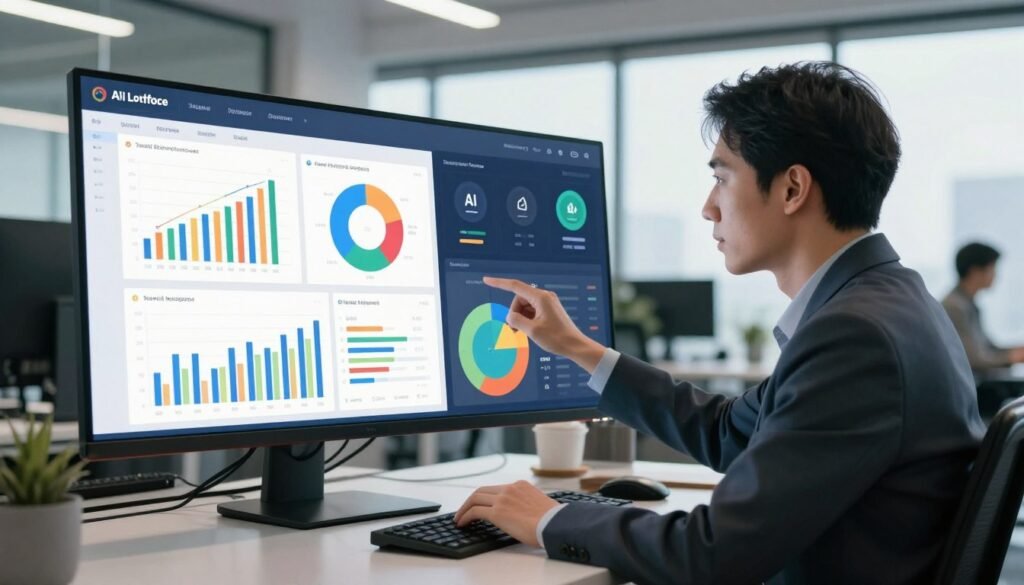
For too long, workforce planning was a once-a-year exercise, a static budget number in a spreadsheet. It was about filling seats based on last year’s headcount, not building a dynamic, future-ready team. This reactive approach is being replaced by a new paradigm: strategic, data-driven workforce planning powered by artificial intelligence. This isn’t just about filling open roles; it’s about proactively architecting your organization’s human capital to meet tomorrow’s challenges.
Modern AI tools transform this critical function from a rear-view mirror exercise into a forward-looking, predictive discipline. By analyzing vast datasets and identifying complex patterns, these systems provide a dynamic, real-time view of your talent landscape. This shift enables a fundamental change: from guessing to knowing, and from reacting to anticipating.
From Reactive to Predictive Planning
Traditional planning was often a guessing game. You’d look at last year’s headcount, factor in a growth percentage, and hope for the best. AI changes the game by analyzing internal and external data to forecast talent needs with remarkable precision. Analytics platforms can now predict future needs with up to 85% accuracy, according to industry studies, allowing you to see talent gaps before they become business risks.
This isn’t just about filling a future open role. It’s about understanding the trends that will shape your business. Which skills are becoming obsolete? Which are emerging as critical? AI-driven workforce planning models can identify these trends by analyzing job market data, internal skill data, and business growth projections. This moves the entire organization from a reactive, fill-the-seat mentality to a strategic, predictive model where you hire and develop people for the roles you’ll need in 12, 24, or 36 months.
Scenario Modeling for Strategic Decisions
What if you’re considering entering a new market or launching a new product line? Traditional planning might offer a best guess. AI-powered scenario modeling changes the game. Leaders can now ask “what if” and get data-driven answers.
These tools can model the impact of a new office, a product launch, or a market expansion on your headcount and skill requirements. They simulate different business scenarios—like a 20% increase in sales or a shift to a new service line—and project the precise impact on your talent needs. This allows for strategic decisions about hiring, reskilling, or restructuring long before a crisis hits, turning planning into a strategic advantage.
Skills Mapping and Gap Analysis
The core of strategic workforce planning is understanding the gap between the skills you have and the skills you’ll need. AI-powered tools can map the entire organization‘s skills inventory, creating a living, breathing skills database. This isn’t a static list; it’s a dynamic map of your company’s collective capability.
By overlaying this internal skills map with future business goals, AI can pinpoint critical skill gaps 2-3 years in advance. The system might reveal, for example, that while you have ample project managers, you have a critical shortage of people with advanced data analytics skills needed for a future AI-driven project. This “heat map” of skills—showing surpluses in some areas and deficits in others—enables leaders to make strategic decisions about hiring, reskilling, and internal mobility long before a project stalls due to a lack of talent.
This forward-looking, data-driven approach transforms workforce planning from an administrative HR task into a core strategic function. It moves the conversation from “how many people do we need?” to “what skills do we need to build the future of our business?” By leveraging analytics to model scenarios and map skills, leaders can build a resilient, agile, and future-ready organization.
4. The Critical Role of Data and Ethics in AI Implementation
The true power of AI in HR isn’t just in the algorithms, but in the ethical framework that guides their use. For organizations, the success of any AI applications in talent management hinges on a foundation of high-quality data and a commitment to ethical principles. Without these, even the most sophisticated systems can produce flawed, biased, or even harmful outcomes.
The move to AI-driven talent management is a major step for any organization. Its long-term success depends on more than just the technology. It requires a strategic focus on the quality of information that fuels these systems and a steadfast commitment to fairness and privacy. This section explores the three pillars of responsible AI adoption: data integrity, algorithmic fairness, and legal compliance.
Ensuring Data Quality and Integration
The old computing adage “garbage in, garbage out” has never been more relevant. The quality of insights from any AI tool is only as good as the data it’s fed. For organizations, this means the AI’s success depends entirely on clean, comprehensive, and unbiased data.
This starts with integrating data from often-siloed sources: the Human Resource Information System (HRIS), the Applicant Tracking System (ATS), and performance management systems. A unified, clean dataset is the bedrock of effective AI. Incomplete or biased historical data will only teach the algorithms to replicate past biases and inaccuracies.
Mitigating Bias and Ensuring Ethical AI
One of the most significant risks in AI implementation is the perpetuation of human bias. AI models learn from historical data, and if that data reflects human prejudices, the AI will, too. This can create a dangerous feedback loop.
For example, if historical hiring data shows a pattern of favoring candidates from certain schools or with specific keywords on their resumes, the AI might learn to prioritize these traits, overlooking other qualified candidates. Studies show AI can reduce bias in hiring by up to 40%—but only when algorithms are properly audited and trained on diverse, representative data sets.
“You can’t have ethical AI without diverse data. The goal isn’t just to avoid bias, but to actively build fairness into the system from the ground up.”
Regular audits of AI systems are crucial. This involves not just technical checks, but also monitoring for disparate impact on protected groups. The goal is to move from a “black box” model to a transparent, auditable process.
Navigating Legal and Privacy Considerations
As organizations deploy AI, they must navigate a complex web of regulations like the GDPR in Europe and the CCPA in California. These regulations give individuals rights over their data and require transparency in automated decision-making.
This means being clear with candidates and employees about when and how AI is used in the hiring process. Transparency is non-negotiable. Organizations must inform individuals about automated decision-making processes and, in many cases, provide a human-in-the-loop for final decisions.
The following table highlights the shift from a compliance-focused to a proactive, ethical framework:
| Aspect | Traditional, Compliance-First Approach | AI-Optimized, Ethics-First Approach |
|---|---|---|
| Primary Focus | Avoiding legal penalties, checking regulatory boxes. | Building trust through ethical design and proactive fairness. |
| Data Handling | Data is collected for specific, immediate uses; often siloed. | Data is treated as a strategic asset, governed by principles of privacy-by-design and transparency. |
| Bias Management | Bias is addressed reactively, often after a problem arises. | Bias is proactively audited for in algorithms and training data sets before deployment. |
| Transparency | Processes are often opaque; decisions are not easily explained. | AI decisions are explainable and can be audited. Candidates are informed of AI use. |
| Legal & Ethical Posture | Focused on minimum compliance with laws like GDPR, CCPA. | Exceeds compliance, embedding ethical principles into the AI’s design and governance. |
Ultimately, the responsible adoption of AI in talent management is not a technical challenge alone. It is an organizational commitment to building fair, transparent, and accountable systems. By prioritizing high-quality data, actively mitigating bias, and navigating the legal landscape with integrity, companies can build not only smarter, but also more just and effective talent applications.
5. The Tangible Business Impact and ROI
For a business to thrive in a dynamic market, its talent strategy must be agile and data-driven, a reality where AI-powered tools deliver undeniable business impact. The return on investment extends far beyond simple cost-per-hire metrics, fundamentally altering an organization’s strategic position.
Quantifiable Benefits: Efficiency and Cost Savings
The financial case for AI in talent management is compelling. Leading companies are reporting a 30-50% reduction in time-to-hire and a 20-30% decrease in cost-per-hire. Furthermore, AI-driven workforce planning can optimize staffing, potentially reducing overall labor costs by up to 20% through strategic alignment of resources. This leads to significant gains in operational efficiency, allowing teams to focus on high-value strategic work.
The most immediate benefits are seen in the recruitment funnel. The automation of screening and scheduling drastically cuts time-to-fill for critical roles, getting top talent in the door faster. This operational efficiency translates directly to the bottom line by getting productive employees contributing revenue sooner.
Enhancing Candidate and Employee Experience
The benefits extend beyond cost metrics. A streamlined, AI-enhanced process provides a faster, more transparent, and fairer experience for candidates. This positive experience reduces unwanted turnover by fostering a strong, positive first impression of the company’s culture. When employees feel their career development is supported by personalized, AI-driven learning paths, engagement and retention soar. This directly builds a more resilient and dedicated workforce.
Building a Future-Ready, Agile Workforce
The ultimate strategic advantage lies in building an agile, future-ready organization. AI-powered tools provide the foresight and flexibility needed to adapt. This capability allows companies to pivot quickly in response to market changes, securing a significant competitive edge.
The value creation includes:
- Better Strategic Hires: AI-driven analytics move beyond resumes to identify candidates with the right potential and cultural fit, leading to higher-quality hires who innovate and drive growth.
- Higher Productivity & Innovation: By automating routine tasks and providing data for strategic decisions, AI frees human capital for creative and complex problem-solving, directly fueling innovation.
- Strategic Agility: With predictive analytics, organizations can model different business scenarios, from market expansion to new product lines, and understand the precise talent implications, turning workforce planning into a strategic advantage.
For forward-thinking organizations, this is not an IT expense but a strategic investment. It builds a more resilient, skilled, and engaged workforce, directly fueling sustainable business growth and achieving long-term strategic goals.
6. Conclusion: Integrating AI for a Human-Centric Future of Work
The integration of AI into HR isn’t a distant future; it’s a present-day strategic imperative for forward-thinking organizations. With 93% of Fortune 500 CHROs already integrating these technologies, it’s clear this is a mainstream, strategic priority, not a fringe experiment.
This new era is defined by a collaborative partnership. The true talent management opportunity lies in using AI to augment human intelligence, not replace it. This partnership frees leaders from administrative tasks, allowing them to focus on strategic planning and the human elements of performance development.
The true power of AI is realized when used ethically and strategically to empower people. When implemented with a focus on fairness and transparency, AI becomes a powerful tool for enhancing the workforce experience and driving organizational success. This ethical and strategic adoption is key to building a resilient, adaptable organization.
Ultimately, for competitive businesses, leveraging AI in talent management is no longer optional. It is a strategic imperative for building a future-ready, human-centric organization. The final recommendations are clear: embrace this collaborative future to build a more agile and empowered workforce.