
This short guide shows how modern, AI-driven systems help managers cut admin work and focus on higher priorities.
In practical terms, these solutions automate routine tasks, pull clear insights from data, and speed up decision-making. That frees time and raises productivity across teams.
Expect real workflows, not hype: planning, hiring, coaching, and performance talks are the focus. The list that follows highlights options that reduce troubleshooting and improve follow-through.
You’ll see categories for productivity and organization, communication and content creation, coaching and training, hiring and onboarding, and performance and team health. Each entry ties to measurable results like saved time, clearer goals, and better execution.
Remember: the best systems pair automation with human judgment so organizations keep a people-first approach while gaining efficiency. The article draws on product capabilities such as dashboards, universal search, transcription, simulations, and analytics to help readers match solutions to their needs.
Key Takeaways
- AI-powered systems let managers save time by automating routine work.
- Focus is on real workflows: planning, hiring, coaching, and reviews.
- Expect gains in productivity, clarity, and measurable follow-through.
- Top solutions mix automation with human judgment for people-first results.
- Look for dashboards, search, transcription, simulations, and analytics when choosing.
Why AI-powered leadership tools matter for managers right now
Managers need clear signal paths now more than ever to cut through constant noise. Fragmented systems and endless admin hide the signals that matter. That makes quick, confident action harder.
Saving time by automating repetitive work and admin
Save time on routine work like meeting summaries, scheduling, reminders, first-draft writing, and repetitive status chasing. Automating those tasks frees leaders to spend more minutes on 1:1s and coaching.
Better decisions with data-driven insights and analytics
Combine messy inputs—surveys, notes, dashboards, goal tracking—into clear data-driven insights. Platforms such as Culture Amp surface sentiment and trends so managers can act without digging through spreadsheets.
Stronger communication and coaching without losing the human touch
Use technology as support: draft messages, polish tone, and summarize meetings to improve communication and productivity. Coaching, empathy, and judgment remain human responsibilities.
- More time for 1:1s and priority setting.
- Clearer prioritization from actionable insights.
- Choose solutions that fit existing stacks to avoid added complexity.
leadership tools ai for productivity, organization, and fewer distractions
Replace scattered apps with a single workflow that keeps teams focused on priorities and progress. Think of this set as your daily operating system: fewer tabs, fewer distractions, and faster progress on what matters.
Monday.com for work management, dashboards, and automation
Monday.com gives managers dashboards, automation, reporting, and Kanban boards to track work across a team. Dashboards show progress against goals so leaders can reduce manual follow-ups and shrink status meetings.
The Kanban view surfaces blockers early. Managers re-balance workloads and keep productivity and efficiency on track without constant check-ins.
Dropbox Dash for universal search, smart organization, and AI chat
Dropbox Dash indexes files across Google Workspace, Microsoft 365, Slack, Notion, and Trello so users find performance docs and meeting notes instantly.
Use Stacks to group related content by person, project, or topic. Dash’s AI Chat summarizes notes, drafts onboarding messages, and answers questions from connected company content to help managers save time while staying consistent.
Otter.ai for meeting transcription, speaker tags, and searchable notes
Otter.ai turns meetings into searchable transcripts with speaker tags, timestamps, keyword search, and annotations. These records reduce misalignment and make follow-through measurable.
Shared transcripts become reusable references for goals, action items, and progress checks.
Talla.ai for knowledge management, internal support, and workflow automation
Talla.ai uses natural language chat to retrieve policies, answer process questions, and trigger workflow steps. That reduces repetitive questions and speeds internal support for teams.
Automated responses and task routing free managers to focus on coaching and priorities instead of repeating answers.
- Selection filter: pick one work-hub (work management), one knowledge/search layer, and one meeting-capture tool to avoid sprawl and get clearer data, insights, and progress.
AI communication and content creation tools for leaders who need clarity and speed
When executives write and present with confidence, the whole organization acts faster. Clear messages shorten decision cycles and build trust across teams.
Grammarly for polished writing, tone, and error-free executive communication
Grammarly flags grammar, spelling, punctuation, and style. It tightens tone and keeps messages consistent when time is short.
Textio for inclusive language, predictive analytics, and message effectiveness
Textio uses algorithms and machine learning to give real-time predictive analytics. It highlights biased or weak language so announcements and job posts reach diverse audiences.
Result: better employee experience and clearer internal communication.
Prezent for fast, on-brand presentation creation and team collaboration
Prezent auto-generates slides, formats text, adds visuals, and applies brand styles. Teams can edit in parallel, cutting review cycles and boosting productivity.
| Product | Key features | Primary benefit |
|---|---|---|
| Grammarly | Grammar, tone, consistency | Clear executive messages |
| Textio | Predictive analytics, inclusivity flags | More effective job posts and announcements |
| Prezent | Auto slides, branding, collaboration | Faster board-ready decks |
AI coaching and training platforms to build leadership skills at scale
Modern coaching systems focus on practice and nudges to turn learning into daily habits.
What an AI coach is: a platform that uses natural language, machine learning, and analytics to give personalized practice, feedback, and micro-interventions tied to goals and performance signals.
How it differs from an LMS or mentoring: an LMS mainly distributes courses. Mentoring depends on limited human time. An AI coach delivers on-demand practice, simulated conversations, and always-on nudges that support behavior change.
Platform highlights
Hone: blends live cohorts, simulations, nudges, and behavior-change analytics that measure outcomes beyond attendance.
BetterUp: pairs AI-augmented coaching with well-being and long-term development tracking for employees.
CoachHub AIMY: uses algorithms for AI matching and offers multilingual coaching at global scale.
Skillsoft CAISY: provides conversation simulations and real-time feedback for hard communication moments.
TalentLMS AI Coach: offers a user-friendly interface with guided learning paths for fast deployment.
Rocky.ai: delivers lightweight daily prompts, reflection, and goal tracking to build habits without heavy programs.
“AI coaching scales practice and nudges so managers can turn learning into measurable behavior change.”
| Platform | Core feature | Primary benefit |
|---|---|---|
| Hone | Simulations + behavior analytics | Measurable skill growth |
| BetterUp | AI-augmented coaching + well-being | Holistic employee development |
| CoachHub AIMY | AI matching, multilingual | Global scale and fit |
| Skillsoft CAISY | Conversation practice | Real-time feedback for communication |
How to choose: match platform depth (simulations vs coaching network), analytics maturity, and integration resources to your organization’s scale and needs.
AI tools for hiring, onboarding, and employee support
Talent systems that automate routine hiring work let managers focus on people, not paperwork.
How this shows up: better hire quality, faster onboarding, and consistent employee support lower manager load and boost team stability.
Attract.ai
Attract.ai uses machine learning for sourcing and skill matching. It automates outreach and helps reduce bias in screening to raise hiring efficiency.
HireVue
HireVue adds AI-assisted screening and video interview workflows. Standardized evaluations and ATS integrations speed hiring and cut scheduling friction for managers.
Paradox.ai, Talmundo, Leena.ai
Paradox.ai engages candidates with the Olivia chatbot for instant Q&A and interview scheduling, improving responsiveness without extra admin.
Talmundo automates paperwork, training schedules, and compliance checks. Its engagement analytics flag early onboarding risks so teams can intervene.
Leena.ai provides 24/7 HR support via natural language chat. That reduces repetitive tickets and surfaces analytics and insights to improve employee experience.
“Choose systems that integrate with existing HR stacks and define what data is captured and how it will be used.”
| Product | Core capability | Primary benefit |
|---|---|---|
| Attract.ai | Machine learning sourcing & skill match | Faster, fairer candidate shortlists |
| HireVue | AI screening + video interviews | Standardized evaluation and speed |
| Paradox.ai | Recruiter chatbot (Olivia) | 24/7 candidate engagement |
| Talmundo | Onboarding automation & analytics | Smoother new-hire ramp |
| Leena.ai | HR chatbot + engagement analytics | Consistent employee support |
AI performance, engagement, and team health tools for better management
A clear people dashboard turns scattered signals into actionable steps for teams.
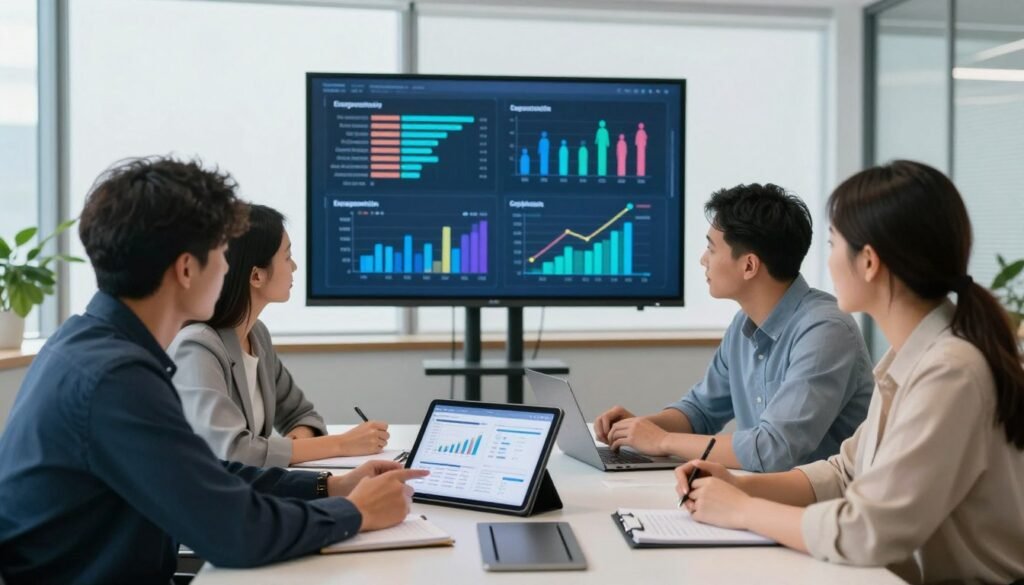
Position this as the leadership dashboard for humans: combine sentiment, pulse survey results, and performance signals so managers get interpretable insights, not raw metrics.
Culture Amp: sentiment analysis and smarter performance tracking
Culture Amp uses artificial intelligence to surface trends from employee sentiment and productivity data. That helps performance conversations rely on patterns instead of gut feel.
Workleap Officevibe: pulse surveys and pattern detection
Officevibe runs lightweight, anonymous pulses and applies algorithms to detect morale shifts. Managers see early warnings and can respond before issues grow.
Lattice: analytics-driven signals and interpretability
Lattice emphasizes clear analytics and explains how results are derived. Transparency builds trust and supports accountable decision-making.
Practical playbook for using feedback trends
- Identify recurring themes in feedback.
- Pick one behavior to change and set a clear goal.
- Define measures and track progress for a set period.
- Coach managers with aggregated data, keeping comments anonymous.
Coaching with data: use trends to guide 1:1s, recognition, and workload talks while protecting psychological safety.
Governance tip: decide who sees which insights, set a review cadence, and avoid reacting to tiny samples.
| Product | Core capability | Primary benefit |
|---|---|---|
| Culture Amp | Sentiment analysis + trend surfacing | Clearer performance conversations |
| Officevibe | Anonymous pulse surveys + pattern detection | Faster morale visibility |
| Lattice | Analytics + interpretability | Transparent, trusted signals |
“Consistent feedback loops improve communication norms and reduce churn risk.”
Conclusion
, ,
Begin with a single pain point—meet notes, search, or onboarding—and build from there. The best tools help managers save time, lift productivity, and keep teams focused by automating routine work and surfacing usable data and insights.
Pick a small, high-impact stack: productivity/organization, communication and content creation, learning and training, hiring/support, and performance analytics. Choose systems that fit existing user habits and a user-friendly interface to speed adoption today.
Adopt responsibly: insist on transparency, interpretability, and privacy controls for performance and employee use. Measure outcomes with simple baselines—time saved per week, faster onboarding, better feedback quality, and higher learning participation—so ROI is visible.
When technology and human judgment work together, skills grow and communication improves. Better rhythms across the team boost execution and customer outcomes, including higher sales and stronger support.