
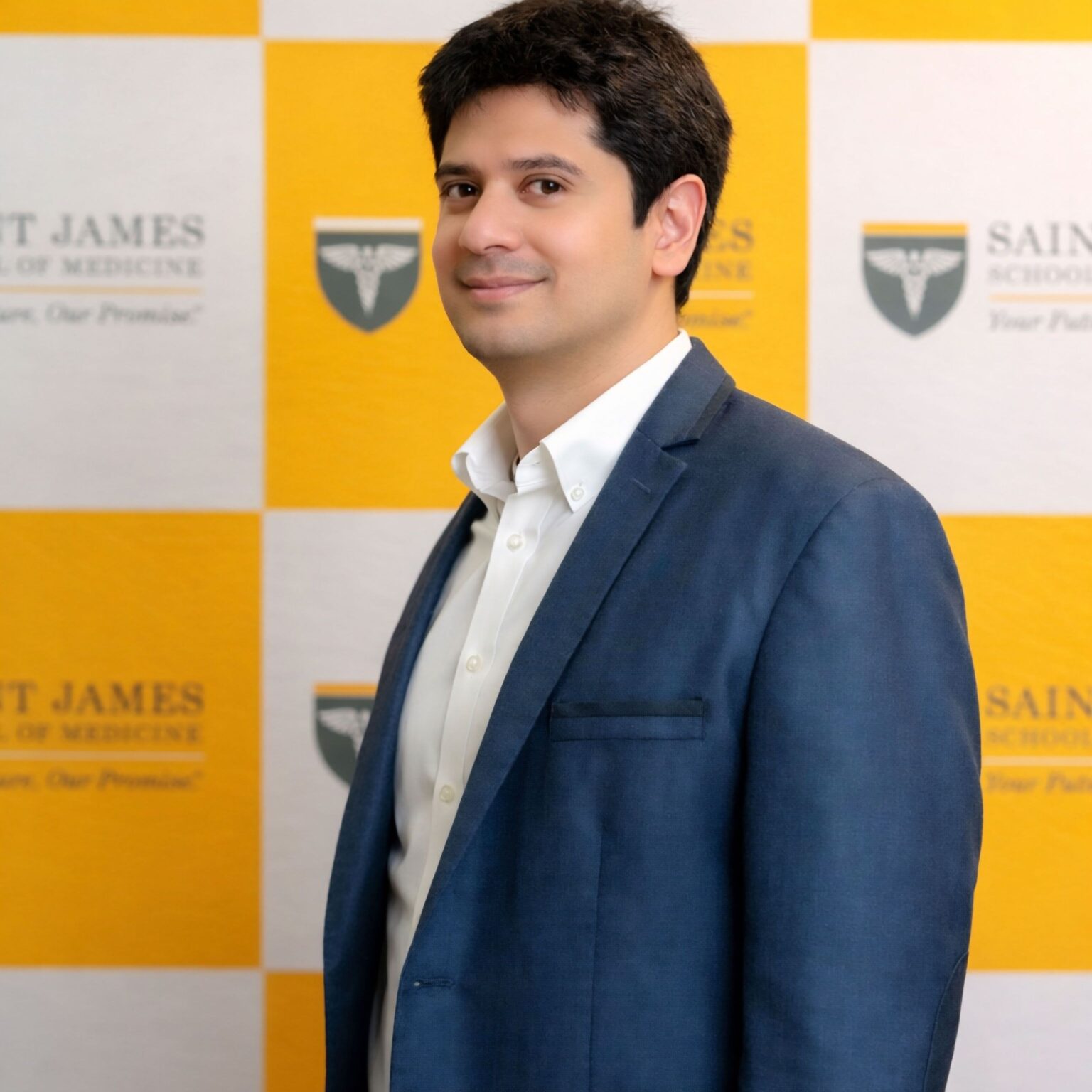
Kaushik Guha on access, accreditation and medical education
Kaushik Guha is Executive Vice President of Saint James School of Medicine, a family-owned medical school focused on accessible, affordable education. Guha explains how referrals helped the school grow, why it consolidated campuses, and how it is adapting its curriculum while putting student support ahead of rapid enrollment.
Trust in medical education takes time to earn. Invest in accreditation, government relationships, clinical training and students before spending on marketing or trying to grow enrollment quickly.
What’s the short story of how your business started, and what makes it genuinely different from the other options your customers have?
My father left Calcutta as a young man with less than ten dollars in his pocket, made his way to Scandinavia, and earned a PhD and then a DSc there. He got into Caribbean medical education in 1981, when the industry was barely five years old, and spent almost twenty years watching capable students get turned away from US medical schools. In 1999 he started Saint James to do it properly. His first building was a vacated schoolhouse the Minister of Education rented to him for $100 a month, and the furniture was donated by a university that was moving.
What makes us different is how we see the student. Most of medical education uses family money and academic pedigree as stand-ins for ability, and they are poor ones. A student with a 517 on the MCAT is going to do well anywhere, with or without guidance. We look for the student who is willing to put in the work and needs a school that will put in the work with them. A few years ago a student called me right after she matched, crying so hard I could barely understand her. Her mother cleaned houses and her father worked an assembly line. She wanted me to know she would not have been a physician at all if our tuition had been higher. Every student matters here. They are not numbers.
We’re also still family owned, in a sector that has mostly been bought by public companies and private equity. My sister and I run the school now along with a team of dedicated executives, many of whom have been with us for more than a decade. That lets us make decisions on a twenty-year horizon.
How did you win your first customers, and where does most of your new business come from today?
The first class was fewer than ten students. Most of them had been told, or had told themselves, that they weren’t going to make it into medicine. My father had a reputation as a great professor, and what he really did for that first group was make them believe they could do it. They told their friends, and that’s how the school grew. It was almost entirely word of mouth.
It still is. Most of our students today come from referrals by alumni and current students in the US and Canada, with digital behind that. In medical education the product takes four years to deliver and another three to prove, so reputation moves slowly. People see the value. Tuition alone at a private US medical school runs about $263,000 over four years. Ours is more than $100,000 less, with no state funding, and our graduates sit the same licensing exams and compete in the same residency match.
What’s one decision that changed the direction of your business, and one mistake that taught you the most?
The decision was consolidating to a single campus. We ran two campuses on two islands for years. In 2024 we closed Anguilla and put everything into St. Vincent and the Grenadines. It was hard on people and it was the right call. One faculty, one curriculum, one standard, and one government relationship that we can invest in properly.
The mistake was treating being a Caribbean school as something to apologize for. For years we marketed ourselves as a close substitute for a US school. That was wrong. Our students see multiple countries’ health systems, they train in Mexico and in the Amazon interior of Suriname, and they see diseases like dengue and Chagas that US physicians are now starting to encounter at home. That is an advantage, and we should have been saying so much earlier.
What has changed in your industry or in what your customers expect over the last couple of years, and how have you adapted?
Students arrive expecting more than lectures and a test prep book. They’ve grown up with on-demand everything and they now have AI in their pocket. At the same time, the diseases their future patients will have are changing as tropical illness moves north.
So we rebuilt the first two years into a system-based curriculum with team-based learning, and we’re building AI tools on top of it, including a tutor trained on our own material and score reports that tell each student exactly what to study next. On the clinical side we built a Diploma in Clinical Tropical Medicine with partners in Suriname, accredited by the American Society of Tropical Medicine and Hygiene, and a global health track in Mexico. We want a graduate who is more adaptable than the one we were producing ten years ago.
If you were advising someone starting out in your industry today, what would you tell them to do first, and what would you tell them to ignore?
It was easier in 1999. Accreditation wasn’t the gate it is today. Now it’s a badge of honor, and a hard one to earn. There are dozens of medical schools in the Caribbean and only a minority of them are accredited. Governments understand this and have become much stricter about who gets a charter. So the first thing I’d tell someone is to welcome the scrutiny, because the scrutiny is what makes the degree worth something. Accreditation, government relationships, and clinical training sites come before a single dollar of marketing.
I’d also tell them to have a real reason to exist. New medical schools keep opening in the US and there are more seats there than ever. A Caribbean school has to offer something a student can’t get at home.
What to ignore is the pressure to grow enrollment fast. Enrollment is a result of doing right by students, and every bad story in our sector started with a school that chased it directly. And ignore the stigma. If we do the work, the graduates end it for us.
Thank you to Kaushik Guha and the team at Saint James School of Medicine for sharing what actually worked with Leaders Perception readers.
Want to tell the story behind your business?
Leaders Perception publishes interviews with business owners and leaders every week. Five questions, about ten minutes, no calls. It is free and every completed interview gets published.