Brand strategy vs marketing strategy defines two practical areas leaders use to grow a business today. One builds a unique identity through values, consistent messaging, and visual assets. The other runs campaigns that promote products and drive sales.
In today’s fast channels and crowded market, clarity matters. A clear promise shapes customer perception, while active campaigns bring that promise to life and generate immediate results.
This article will give clear definitions, a side-by-side breakdown, real-world examples, and a step-by-step alignment framework. Expect to learn how focus, time horizon, KPIs, and tactics differ and how they connect for long-term growth and customer retention.
Key Takeaways
- Understand the practical difference between identity-building and campaign work.
- See how short-term activation supports long-term equity.
- Learn key KPIs for perception and for conversion.
- Find examples that show alignment in real business settings.
- Get a simple framework to sync both efforts for sustained growth.
Why the Difference Matters for Business Growth and Customer Loyalty
When customers trust a business, they decide faster and with less doubt. Trust lowers perceived risk, especially when product choices look alike. That makes purchase paths shorter and cheaper to convert.
The Edelman Trust Barometer (2019) found trust influences over 80% of buying decisions. This sharp stat shows why leaders prioritize credibility, not just campaign volume.
Loyalty forms when people repeatedly receive the promise a company makes — not just after slick ads. Consistent delivery builds repeat purchases, referrals, and pricing power over time.
By contrast, fast campaign wins without a solid foundation create “spiky” results. You may see high short-term attention, but inconsistent messaging, mismatched visuals, and shifting positioning weaken customer connections and hurt long-term growth.
- Healthy growth: credibility, retention, referrals.
- Spiky wins: transient sales, lower repeat rate, weakened trust.
Over-invest in fleeting attention and executives lose compounding value in retention and lifetime revenue.
How brand trust influences buying decisions
Trust translates directly into measurable outcomes executives care about: higher retention, more referrals, stronger repeat purchases, and the ability to command better prices.
What Is a Brand Strategy?
A clear blueprint shapes how people remember and choose a company over time. A good plan defines what a company stands for and how it behaves across channels.
Purpose, mission, and vision answer three simple questions: why we exist, what we do, and where we are headed. Those elements link to core values that guide decisions, hiring, and culture.
Brand purpose, mission, vision, and core values
Purpose gives meaning. Mission maps daily work. Vision sets the long view. Together they form the core rules that steer product and service choices.
Positioning and the promise you make to customers
Positioning is the unique place you own in customers’ minds. It also defines the promise people can expect every time they interact with the company.
Brand identity systems: visual identity, voice, and consistent messaging
Identity systems turn intent into tangible assets. Visual identity covers logo, color, and typography. Voice and tone shape how you speak. Messaging rules keep communications consistent.
Consistency in promise and delivery builds trust faster than flashy visuals alone.
- Not just a logo: This is a framework for products, experience, and comms.
- Target clarity: Defining the target audience ensures messages land with the right people.
| Component | What it answers | Key outputs | Why it matters |
|---|---|---|---|
| Purpose | Why we exist | Mission statement, positioning line | Creates meaning and alignment |
| Core values | Guiding behaviors | Decision rules, hiring criteria | Shapes culture and trust |
| Identity system | How we look and speak | Logo, visual identity, tone | Ensures recognition and consistency |
| Positioning | Place in the market | Value promise, target audience | Defines expectations and competitive space |
What Is a Marketing Strategy?
To convert prospects, teams need a concrete playbook that directs activity and timing.
A marketing strategy is the actionable plan to reach a target audience, generate demand, and drive sales through coordinated campaigns.
It translates a value proposition into clear execution: what to say, where to say it, and how often. This makes creative, timing, and budget decisions easier for teams that must act quickly in a shifting market.
A campaign-driven plan to reach a target audience and drive sales
Common channels include content, social media, email, PR, and events. Each channel serves a different goal—awareness, engagement, lead capture, or conversion.
Marketing levers: product positioning, pricing, and distribution
Beyond promotion, teams use product positioning, pricing, and distribution to shape demand. Those levers influence where campaigns land and how offers perform.
- Feedback loop: engagement and campaign metrics guide quick creative and targeting changes.
- Flexible cadence: plans are revisited often to reflect shifts in the market and competitive moves.
- Channel mix: balance content and paid media to move prospects from awareness to purchase.
brand strategy vs marketing strategy: The Core Differences
Clear distinctions between long-term identity building and short-term activation shape smarter decisions.
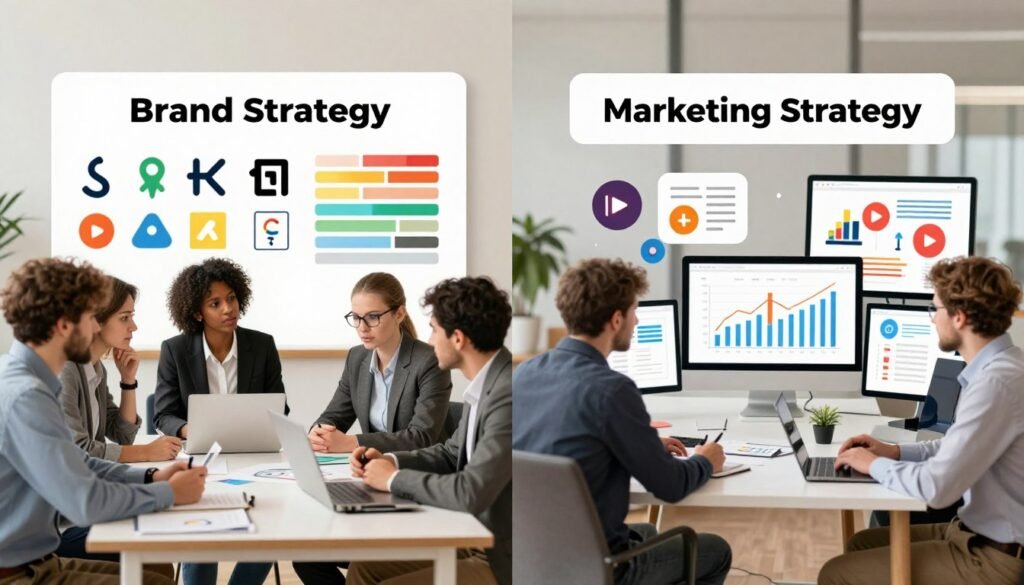
Primary focus
Reputation and emotional connection center on who you are, what you stand for, and the feelings customers associate with you.
Promotion and revenue concentrate on messages, offers, and channels that drive immediate demand.
Goals and KPIs
Long-term goals measure equity, trust, and loyalty. Typical KPIs include awareness lift, repeat purchase rate, and net promoter score.
Short-term goals aim for conversions, leads, and revenue. Common KPIs are CAC, conversion rate, and pipeline value.
Approaches and tactics
Identity work uses storytelling, customer experience, and consistent touchpoints to build a durable connection.
Activation relies on ads, targeted content, offers, and engagement loops to move prospects quickly through the funnel.
Time frame and decision lens
A stable plan stays steady unless there is a major pivot. Campaign work adapts fast to channel trends and results.
If messages feel inconsistent, fix the foundations; if reach or pipeline lag, sharpen execution.
| Focus | Primary KPIs | Typical Tactics | Time Frame |
|---|---|---|---|
| Reputation & connection | Awareness, NPS, retention | Storytelling, experience, identity rules | Long-term, stable |
| Promotion & revenue | Leads, conversions, CAC | Ads, content campaigns, offers | Short-term, adaptive |
| How they align | Shared metrics: CLV, brand lift | Consistent messaging across campaigns | Ongoing coordination |
Key Components of a Strong Brand Strategy
Concrete guiding values help teams hire, partner, and design products with intent. When values are clear, they act as a filter for hiring choices, product decisions, partnerships, and how customers are served. This makes culture visible, not just a poster on a wall.
Defining values that guide decisions and culture
Values should include definitions and observable behaviors. Write short value statements and list actions that show the value in practice. Use these during interviews, vendor selection, and product roadmaps to keep choices aligned.
Building recognition through a cohesive visual identity
A cohesive visual identity boosts recognition and recall. Louis Vuitton’s LV monogram and consistent palette show how visuals build long-term equity. Aesop’s minimalist packaging and apothecary store design reinforce a quiet, crafted image across touchpoints.
Creating connection through story and tone
A clear story and consistent tone make your message memorable. Stories turn product lists into emotional reasons to buy. Tone keeps the experience familiar on social, packaging, and stores.
“Consistency in identity drives trust, repeat purchases, and word-of-mouth.”
Practical outputs to create
- Purpose statement that explains the core promise.
- Value definitions with behaviors to guide hiring and partners.
- Positioning line that explains who you serve and why it matters.
- A simple messaging hierarchy: core message, proof points, and call-to-action.
| Component | Output | How it helps |
|---|---|---|
| Values | Definitions + behaviors | Guides hiring, partnerships, and product choices |
| Visual identity | Logo, palette, packaging rules | Improves recognition and recall |
| Story & tone | Core narrative, voice guidelines | Builds emotional connection and memorability |
What a Strong Marketing Strategy Includes in Today’s Market
A practical plan connects market insight to repeatable tactics that drive sales and retention.
Market research and audience segmentation
Start with interviews, competitor audits, and category trend checks. These methods sharpen who you target and improve message fit.
Segment by behavior, need, and intent so teams can tailor offers for each target audience.
Channel mix and a content plan across media
Choose channels based on where each segment spends time and the funnel stage. Then map owned, earned, and paid media into a clear content calendar.
Common campaign types include launch bursts, always-on growth, and retargeting flows. Tactics differ by channel but should aim at the same goals.
Measurement: traffic, share of voice, CLV, and conversions
Go beyond clicks. Track traffic quality, share of voice, conversion rates, and customer lifetime value. Use Google Analytics, social listening, and periodic surveys.
Research shows investment in inbound marketing often links to a roughly 50% increase in sales.
Repeatable system
- Research → plan → execute → measure.
- Align tactics to goals and optimize based on outcomes.
- Focus on scalable processes, not one-off campaigns, to sustain growth.
How Brand Strategy and Marketing Strategy Work Together
When identity and activation work as a system, every touchpoint pushes the same promise forward.
The system view sets rules: identity, voice, promise, and visual cues. Those rules guide how teams build campaigns and choose channels.
Apply, don’t reinvent. The long-term plan sets guardrails. The shorter playbook uses those guardrails to act fast and measure results.
Aligning messaging so every campaign reinforces identity
Look at Nike’s “Just Do It.” Endorsements, billboards, and social posts repeat the same message. That repetition strengthens recall and trust across touchpoints.
Integrating values into campaigns for authenticity
When values show up in creative, people sense authenticity. Liquid Death pairs punk visuals with humorous posts and sustainability hooks like #DeathToPlastic. That mix helped fuel real market traction and a reported $1.4B valuation.
Keeping consistency across channels while adapting to trends
Operational consistency needs clear guidelines, messaging frameworks, and a review process to prevent drift. At the same time, keep the core promise stable and vary formats, hooks, and distribution to ride trends without dilution.
“Consistent rules let teams move quickly while protecting what makes you recognizable.”
- Set identity rules first, then map them into campaign briefs.
- Use checklists and approvals to keep messaging consistent across channels.
- Test new creative formats that still respect core values and voice.
How to Build and Align Both Strategies
A small set of rules makes it easy for teams to act and stay consistent.
Clarify purpose and core values before scaling
Define your company’s purpose and three to five core values. Keep each value short and list observable behaviors the team can follow.
Clear values reduce inconsistent messages when more people create content, ads, and customer communications.
Identify your target audience with research
Interview current customers, prospects, and competitor customers. Ask about needs, decision drivers, and moments of friction.
Use those insights to shape positioning and real offer language that the sales and product team can use.
Develop identity and a usable story
Create a simple identity kit: logo rules, voice notes, and a one-paragraph story that supports sales and comms.
Make these assets accessible so every team member applies the same rules.
Set SMART objectives and pick channels
Set measurable goals (e.g., increase sales by 15% in Q4; grow awareness by 20% in 12 months). Match each goal to the right channels and tactics.
Implement, monitor, and optimize
Run campaigns, then track Google Analytics, social listening, and brand surveys. Monitor share of voice, web traffic, conversions, and CLV.
Create feedback loops so marketing strategy work improves without drifting off the core promise.
Conclusion
Sustained business growth depends on a steady promise and smart, measurable outreach.
At heart, a clear brand sets who you are and the promise you keep. Practical marketing brings that promise to life and drives action in the market.
Keep the practical split in mind: identity stays stable and guides choices; campaign work adapts to channels, timing, and results. That distinction helps teams decide what to protect and what to test.
Next steps: confirm values and positioning, align messaging, set SMART goals, measure performance, and iterate with feedback loops.
Consistency between the two strategies is what customers feel — and that experience fuels repeat purchases and advocacy over time.