
A messaging strategist guides how a brand talks about what it stands for. This role turns core values into clear language that connects with the right audience. It helps teams across brand, marketing, and sales create consistent, relevant messages.
This article is a practical how-to guide. You will learn research methods, positioning, message hierarchy, brand story crafting, measurement, and ways to get team adoption. The goal is fewer generic lines and stronger resonance with customers.
The modern buyer reacts to relevance and proof, not long feature lists. Good messaging links brand intent to real market needs. A repeatable framework lets teams produce consistent copy without reinventing the wheel each time.
Key Takeaways
- Understand the practical role of a messaging strategist and its impact on brand clarity.
- Build a messaging strategy that unifies marketing, sales, and product language.
- Focus on positioning, message hierarchy, and a repeatable framework for teams.
- Expect clearer communications, better resonance with your audience, and fewer generic claims.
- Measure performance and adapt messages based on proof and buyer response.
Why strategic messaging matters for brands right now
Clear, purposeful communication now decides whether a brand wins repeat customers or fades into the noise.
How customer experience influences loyalty and growth
Seventy-five percent of consumers say customer experience shapes brand loyalty. That means words and actions together build trust and long-term growth.
Why generic B2B content gets ignored
In crowded B2B markets, generic messages become background noise. Emails go unopened, stakeholders tune out, and deals stall because buyers don’t hear a clear “why should I care?”
Consistency as a competitive advantage
Repeatable, aligned messages reduce confusion, speed decisions, and lift conversion by matching expectations to outcomes and proof.
Simple point: a repeatable messaging strategy turns scattered communication into a cohesive story that customers remember and choose.
What a messaging strategist does and where they create impact
A clear message framework turns scattered copy into consistent, fast-moving decisions.
The day-to-day role blends tactical work and bigger-picture strategy. It guides how a brand uses its mission, values, and story as inputs for all team communications.
Core responsibilities and common deliverables
The deliverable is a usable framework and hierarchy of messages. This includes key claims, proof points, and rules for where each line belongs.
Timing and the buyer journey
What to say shifts by buyer stage: early-stage content raises the problem, later content proves your solution. Getting time and order right matters as much as wording.
- Where it appears: website pages, sales decks, emails, ads, onboarding, and leader.comms.
- Cross-functional use: the framework is built to be picked up by any team, not locked in a file.
- Impact: strong strategy shortens debates and aligns priorities across brand, marketing, and sales.
Benefits of working with a brand messaging strategist
When every touchpoint tells the same story, customers start to trust the brand faster. A clear approach reduces confusion and builds a predictable experience across website, email, and social channels.
Building trust through consistency
A cohesive style guide prevents mixed signals. It sets rules for voice, claims, and proof so teams deliver uniform messages every time.
Improve conversion and increase sales
Clear value lines help prospects answer “what’s in it for me” faster. That speeds decisions, improves conversion, and gives sales cleaner talk tracks with fewer objections.
Sharper marketing and better calls to action
When CTAs match intent, ads and campaigns remove friction. Marketing sees higher click-throughs and more qualified leads because the offer and the ask align.
An outside view that clarifies positioning
An external expert spots gaps: fuzzy unique selling points, jargon, or promises that don’t match delivery. Fixes here multiply across channels, so one set of decisions strengthens branding, product, and team performance.
Messaging strategist vs. marketing strategist vs. positioning strategist
Clear roles prevent teams from arguing over wording when the real debate should be about channels or differentiation.
Who owns words, who owns channels, and who defines the category?
The person focused on core language and narrative crafts the message strategy and proof points. They decide what you say and why it matters.
Marketing leaders run campaigns, pick channels, and measure performance. Their job is distribution, budget, and conversion lifts.
How positioning fits in
Positioning answers the “why us” question. It sets a brand’s place in the market and frames competitors and category rules.
For example, McDonald’s is known for being trusted and affordable. That positioning guides both message lines and channel choices.
- Operational clarity: Clear ownership prevents duplicated work and mixed tactical debates.
- How they pair: Positioning sets the space; message strategy turns it into persuasive language; marketing delivers it.
- Decision rule: Debating words and proof points → message; debating category → positioning; debating channels and budget → marketing.
| Role | Primary focus | Typical output | Decision cue |
|---|---|---|---|
| Message lead | Core narrative and proof points | Key claims, message hierarchy, talk tracks | Words and evidence |
| Marketing lead | Channels, campaigns, analytics | Campaign briefs, media plans, performance reports | Channels and budget |
| Positioning lead | Category, differentiation, value context | Positioning statement, competitive frame | Category and market fit |
| How they align | Shared business goals | Coordinated briefs and governance | Clear ownership rules |
How to build a messaging strategy that drives results
Start with business outcomes and work backward to the words that move customers to act.
Step-by-step actions create a repeatable process teams can use. Set SMART goals (example: improve conversion rates by 20% in 90 days) so progress ties to revenue and time-bound targets.
Set clear goals tied to business outcomes
Define target metrics, owners, and a 90-day timeframe. Use goals to prioritize which messages to test first.
Research your target audience
Run interviews, surveys, and competitive analysis. Combine quantitative market data with qualitative insights to avoid generic claims.
Define positioning and unique selling points
Write a short positioning statement that names who you serve, the value you deliver, and 2–3 unique selling points that separate you from competitors.
Create a core message hierarchy and brand story
Build 3–4 key messages with proof points (data, outcomes, case examples). Then craft a concise brand story to humanize the approach and boost engagement.
Monitor, evaluate, iterate
Track engagement, conversion, and customer feedback. Refine messages by channel and repeat the cycle—this work is an ongoing strategic asset, not a one-off project.
| Step | Action | Measure |
|---|---|---|
| 1 | Set SMART goals | Conversion rate, time, owner |
| 2 | Conduct audience research | Interview themes, survey scores |
| 3 | Define positioning & USPs | Positioning statement clarity |
| 4 | Create message hierarchy | Message-readiness and proof points |
| 5 | Test and iterate | Engagement, A/B results, retention |
How to create a brand messaging guide your team will actually use
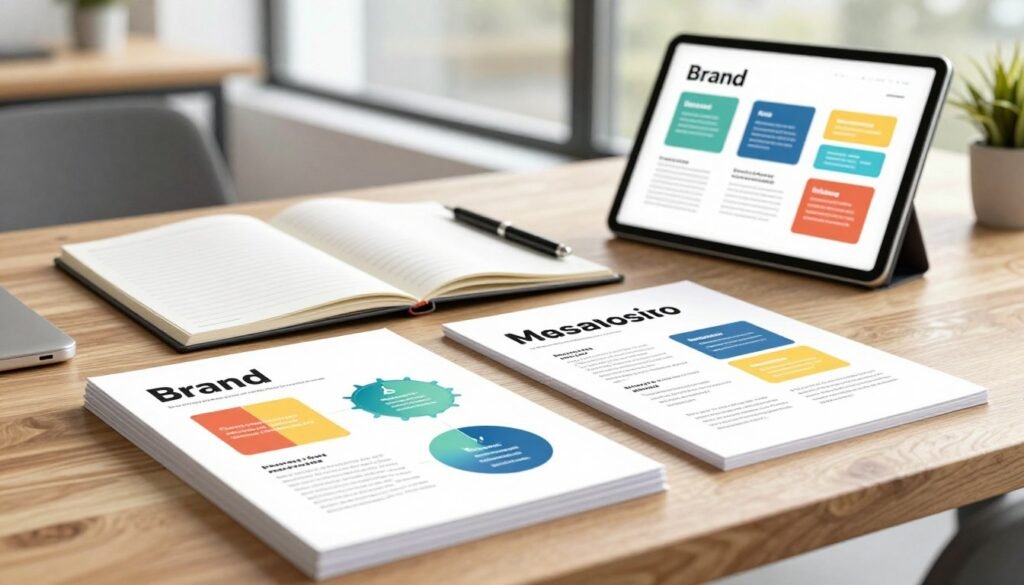
Teams adopt language faster when they have short, copy-ready examples to follow. A good brand messaging guide is an internal playbook that cuts rework and keeps every team aligned on core language.
Document the target audience, personas, and ICP
Start with an ideal customer profile and 2–4 personas. Note pains, motivations, buying triggers, and preferred channels.
Include quick reference rows that list persona goals and the best way to open conversations by channel.
Codify voice and tone
List terms to use and terms to avoid. Show short on-voice vs off-voice examples so writers and sales reps can copy lines instantly.
Translate USPs into messaging pillars
Turn unique selling points into 3–4 repeatable pillars that map to content, sales outreach, and product pages. Add ready-made proof points and examples.
| Section | What to include | Quick use |
|---|---|---|
| Audience | ICP, personas, pains, channels | Persona one-liners |
| Voice | Terms to use/avoid, tone examples | Copy blocks for emails |
| Pillars | USPs, proof, sample claims | Sales scripts & web headers |
| Decision framework | Lead with persona → funnel stage → use case | One-line selection rule |
How messaging consulting improves internal alignment across teams
Internal misalignment quietly turns good plans into mixed experiences for customers.
In many companies, inconsistent messages create inconsistent customer journeys. That hidden bottleneck raises questions, slows approvals, and fractures trust.
Consultants help leaders craft a single brand narrative tied to mission and values so every team hears the same story first. Leaders can then reinforce that narrative in meetings, briefs, and onboarding.
Build a centralized playbook with ready-to-use examples: email opens, elevator pitches, homepage value blocks, and FAQs. These templates speed content creation and keep voice steady without sounding robotic.
- Workshops train sales, marketing, and support to practice core lines.
- Role-play and calibrations reduce “what should we say?” escalations.
- Aligned messages shorten campaign approvals and speed time to market.
The result: consistent customer interactions across prospects, onboarding, support, and renewals because expectations match delivery.
| Activity | Outcome | Who |
|---|---|---|
| Unified narrative | Clear internal signals | Leadership |
| Central playbook | Faster content | Cross-functional teams |
| Training workshops | Consistent customer voice | Sales & support |
How to integrate message strategy into marketing campaigns
Turn your messaging framework into an operational campaign by writing a single brief everyone can use. A clear brief turns the abstract message strategy into concrete actions, timelines, and success metrics teams can follow.
Write a campaign brief with measurable goals and a clear approach
Include these core parts in every brief:
| Item | What to include |
|---|---|
| Objective | Single-line purpose and target segment |
| SMART goal | Example: increase social engagement by 20% by campaign end |
| Offer & CTA | Clear value and the action you want |
| Core message & proof | Headline claim, 2–3 proof points, terms to avoid |
| Metrics & tools | Engagement, CTR, sentiment; monitoring tools like Sprout Social |
Adapt messages by channel without breaking the core narrative
Keep the promise consistent. Use shorter, punchier copy for paid ads. Add more evidence on landing pages. Use story and examples in webinars and long-form content.
For email, lead with the offer and a quick proof point. On the website, expand outcomes and case data. These tweaks preserve one narrative while matching format and intent.
Analyze results with engagement and sentiment signals to improve future campaigns
Track engagement, click-through rates, and sentiment to see which claims land. Use social listening tools like Sprout Social to monitor reception and flag language that confuses audiences.
Keep high-performing lines, refine unclear phrases, and strengthen weak proof points. Then store approved message blocks so future campaigns launch faster and stay consistent.
Common messaging challenges a strategist helps you overcome
Teams often stumble when similar claims blur the difference between options in a crowded field.
Differentiation in a crowded market
Symptom: competitors make the same promises and customers can’t tell you apart.
Fix: refine positioning and sharpen your core value with specific proof points that matter to best-fit customers.
Audience confusion and weak resonance
Symptom: one-size-fits-all content underperforms and ad spend feels wasted.
Fix: segment the audience, map pains by persona, and test tailored lines so your messages land faster.
Inconsistent brand voice across channels
Symptom: sales decks contradict the website or content sounds different from support replies.
Fix: a compact brand messaging guide and message hierarchy keep voice steady across website, sales, and content.
Keeping messages relevant as things change
Symptom: product updates or new competitors make claims feel stale.
Fix: set a cadence to measure performance, retire weak claims, and iterate strategies so value stays current to your market.
How to measure whether your messaging is working
Measurement turns subjective opinions about copy into decisions grounded in results. Without metrics, teams can’t tell whether messages are clearer or merely louder.
Conversion rates that reflect clarity and value
Track landing page conversion, demo requests, and lead-to-opportunity movement. These show whether your core claim and value line answer a buyer’s “what’s in it for me?”
Engagement across email, social, and website
Measure open rates, CTR, time on page, scroll depth, and share rate. Compare short ad copy to longer pages to see where proof or detail improves engagement.
Customer loyalty signals
Retention, repeat purchases, referrals, and reviews reveal if your promise matches delivered experience. High referral rates mean customers value the message and recommend it.
Financial indicators over time
Use revenue growth, pipeline velocity, and margin trends as lagging indicators. These link message changes to business outcomes and show long-term impact.
Use a mixed-method approach: combine quantitative metrics with qualitative inputs like win/loss notes, sales feedback, and support tickets. That mix explains “why” behind the numbers.
| Signal | What it shows | Action |
|---|---|---|
| Landing conversion | Claim clarity | Tighten headline or CTA |
| CTR / open rate | Message relevance | Test subject lines and offers |
| Retention / referrals | Experience match | Refine proof points |
| Revenue / pipeline | Business impact | Adjust prioritization |
How to use the data: refine proof points, tighten claims, reorder the message hierarchy, and keep the brand promise realistic. Measure in short cycles, then validate changes over time to protect long-term value.
How to choose the right messaging strategist and engage experts
Selecting an expert who knows your buyers and market cuts friction across teams.
Start with a short checklist to evaluate candidates. Look for industry familiarity, depth of audience research, a clear process, and a record of linking messages to measurable goals.
What goal alignment looks like in discovery
Good discovery is about numbers and context, not adjectives. The consultant should ask about pipeline metrics, demo-to-close rates, retention, and competitive pressure.
Upskill or hire: quick decision guide
- Upskill when you need repeatable internal capability. Try Product Marketing Alliance, Pragmatic Institute, or CXL for structured training.
- Hire when speed, expertise, or neutral perspective matters. Consultants bring fast framing and battle-tested frameworks.
Sourcing experts and examples
Use marketplaces like Catalant or LinkedIn Services Marketplace when procurement, speed, or flexible budgets matter.
For positioning workshops, consider April Dunford. For strategic narrative work, Andy Raskin is a common example of an expert who clarifies big-picture storylines.
Working with your marketing and sales teams
Run shared workshops, build a centralized framework, and create a single source of truth for approved lines and proof points.
Rollout rules: designate owners, set an update cadence, and require both marketing and sales to use the same claims and evidence in outreach.
| Evaluation item | Why it matters | Red flag |
|---|---|---|
| Industry familiarity | Speeds research and relevance | Generic case studies |
| Audience insight | Drives resonance | No buyer research plan |
| Business goal focus | Ties messages to revenue | Only discusses voice and tone |
Conclusion
A focused narrative and defined position make it easy for buyers to choose you.
A messaging strategist helps turn scattered language into a clear brand plan that customers understand and remember.
Build that strategy on research, firm positioning, and a simple message hierarchy that says what to say, to whom, and when.
Keep the story consistent across website, campaigns, and sales so trust grows and buyer friction drops.
Treat this as an operational framework: document voice and values, run short tests, and use a repeatable campaign brief.
Measure success by conversion, engagement, and loyalty signals—and refine the message over time to stay aligned with product and market changes.