
Quick guide: this opening explains how identity work sets a company’s direction while promotion work activates that direction in real channels.
Brand work builds the long-term foundation that tells customers what a business stands for. Promotion work uses that foundation to reach people, measure results, and tune campaigns for return on spend.
The guide separates identity planning from execution so teams avoid mixing identity-building with short-term promotion. It previews a clear flow: basics, differences, key components, alignment steps, and practical examples.
Attention spans are short across today’s media. Consistent messaging becomes a clear competitive edge. Expect outcomes like clearer goals, sharper messaging, deeper customer insight, and steadier campaign execution.
Evidence: recent work shows integrated identity and performance efforts can lift return on spend by 15–35% (Harvard Business Review).
Key Takeaways
- Identity work defines purpose; promotion work delivers offers to the market.
- Keep planning separate from channel execution to avoid confusion.
- Follow the guide’s step-by-step path for alignment and measurable results.
- Consistent messaging wins when attention is spread thin.
- Practical tips tie strategy to real customers and real channels.
Marketing, brand, and strategy basics you need before you build anything
Agreeing on core principles first keeps every channel focused and prevents mixed signals.
What “brand” really means beyond a logo or product
Brand lives in the audience’s mind as a set of perceptions and associations. It combines reputation, story, and the feelings customers attach to a company.
Identity includes visual cues and verbal tone — logos, taglines, voice, and the cues that signal your value.
What “marketing” does in the market and across media
Marketing creates attention and demand across owned, paid, and earned channels. It spans content, social, email, PR, events, partnerships, and paid performance.
Each channel needs consistent identity cues so campaigns stack instead of resetting every quarter.
How strategy connects goals, customers, and execution
Strategy links business goals to customers and turns choices into plans. It forces decisions about audience, offered value, and which channels matter most.
“A clear plan keeps short-term moves from eroding long-term recognition.”
| Role | Focus | Result |
|---|---|---|
| Brand | Perception, identity, trust | Long-term recognition and equity |
| Marketing | Channels, campaigns, demand | Attention, leads, conversions |
| Strategy | Choices, audience, value | Coherent plans that scale |
What is marketing and brand strategy and why it matters for business growth today
A firm distinction between long-term positioning and short-term campaigns keeps growth predictable and efficient.
How brand strategy shapes perception, trust, and long-term equity
Brand strategy creates long-term equity by shaping what people believe and remember about a company.
When consumers trust a company, they choose it more often; Edelman found trust drives buying for over 80% of respondents.
A strong brand boosts pricing power and retention because familiar signals cut decision friction in crowded markets.
How marketing strategy drives attention, engagement, and sales
Marketing strategy turns that meaning into traffic, leads, and measurable sales through channels and testing.
Engagement matters when it supports conversion, loyalty, or advocacy rather than just vanity metrics.
Integrated work ties creative, media, and measurement so campaigns scale and lift return on spend.
What happens when teams conflate branding and marketing
Mixing roles causes inconsistent messaging, misaligned goals, and wasted spend.
Campaigns then feel like new launches every quarter instead of building value over time.
“Companies with strong branding show about 32% higher revenue growth than peers.”
- Benefit: Clear roles protect long-term equity.
- Risk: Confusion lowers efficiency and harms growth.
- Proof: Integration can lift return on spend by 15–35% (HBR).
Brand strategy vs marketing strategy: the clearest way to tell the difference
Clear roles keep long-term reputation work from being pulled into short-term campaigns.
Focus: brand strategy builds reputation and emotional ties. marketing strategy activates that reputation through promotion, conversion, and measurable results.
Goals: one side targets loyalty, positioning, and differentiation. the other targets leads, revenue, and campaign KPIs.
Time frame: a foundation that shifts slowly versus campaigns that change by quarter, season, or test results.
| Element | Brand strategy | Marketing strategy |
|---|---|---|
| Core focus | Reputation, promise, identity system | Channel mix, offers, media planning |
| Primary goals | Loyalty, positioning, long-term value | Leads, conversions, short-term ROI |
| How decisions appear | Guardrails: voice, promise, visual rules | Campaign plans: budgets, channels, KPIs |
Quick test: if the answer tells “who we are,” it belongs to brand strategy; if it tells “how we hit the number,” it belongs to marketing strategy.
The core components of a strong brand strategy
A solid framework ties purpose, audience insight, and identity into a single plan that guides daily choices.
Brand purpose and core values as your North Star
Purpose explains why the company exists. It helps teams choose when tradeoffs appear.
Core values work as a practical filter for hiring, partnerships, product decisions, and messaging approvals.
Target audience insight and competitive differentiation
True target audience insight goes beyond age or location. It maps motivations, behaviors, and unmet needs.
Clear differentiation answers the “why you” question with specific proof points, not vague claims.
Brand positioning and value proposition
Positioning creates a single, repeatable idea that teams can amplify in campaigns.
The value proposition sets the promise customers remember and helps prioritize offers.
Brand identity: visual identity, voice, and consistent messaging
Visual identity—logo, color, type—gives instant recognition.
Voice sets tone and language rules so every message feels like the same company.
Brand architecture and experience across touchpoints
Choose a structure—house of brands or branded house—that scales without confusing customers.
Tie the brand promise to website, retail, onboarding, support, and social presence so the experience matches the claim.
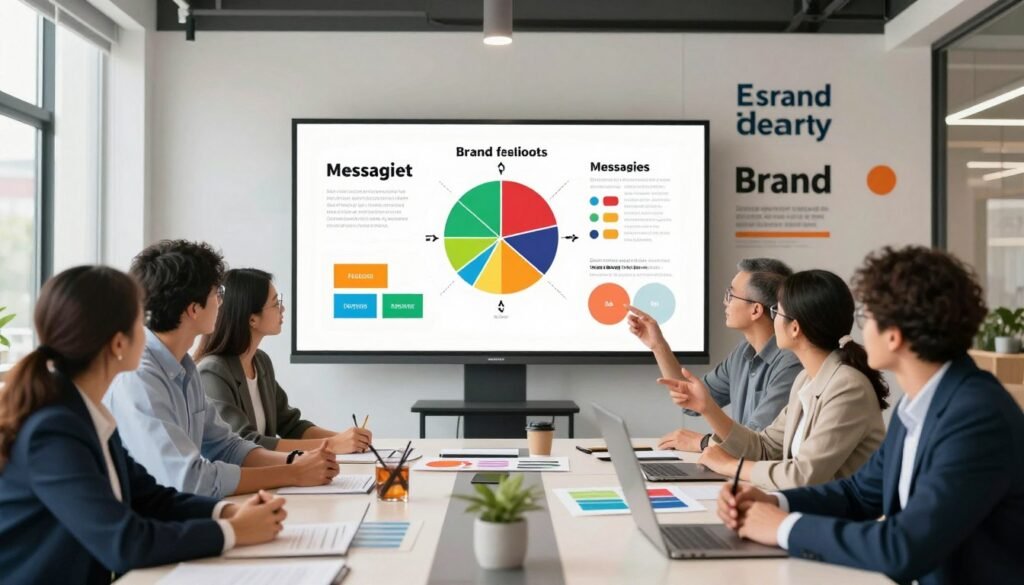
| Component | Core function | Outcome |
|---|---|---|
| Purpose & values | Guides choices and culture | Consistent decisions and trust |
| Target audience | Defines motivations and needs | More relevant offers and messaging |
| Positioning & value | Clarifies unique promise | Repeatable idea that markets can scale |
| Identity (visual & voice) | Creates recognition and tone | Faster recall and loyalty |
| Architecture & experience | Organizes offerings and touchpoints | Clearer customer journeys and retention |
The building blocks of an effective marketing strategy
Begin with clear, timebound objectives so every channel knows when success arrives. Use SMART goals to set specific targets, measurable metrics, attainable steps, relevant outcomes, and tight deadlines.
Clear objectives with SMART goals
Define goals that state a number, a deadline, and an owner. For example: increase organic leads by 30% in 90 days.
Smart channel selection
Pick channels by audience behavior, funnel stage, and budget—not trends. Social media and content build awareness and consideration. PR and events create credibility and moments of high attention.
Message hierarchy and funnel mapping
Use a clear message hierarchy: top promise, supporting benefits, proof, then offer. Map creative so attention becomes engagement and engagement becomes conversions without chasing clicks alone.
Conversion goals, budget allocation, and measurable ROI
Define conversion goals (lead, MQL, SQL, purchase) and track them consistently. Allocate budget allocation by channel performance and test incrementality to measure true ROI. Note: inbound investment often boosts sales—reports show ~50% gains for some firms.
How to align brand messaging and marketing campaigns for consistent brand awareness
Consistent voice across touchpoints makes every campaign add to recognition rather than reset it.
Turning guidelines into campaign-ready creative
Create adaptable templates for headlines, hero visuals, and CTAs so teams can work fast without losing tone.
Supply clear do/don’t examples and a short review workflow with one owner who signs off on final assets.
Integrating values into strategy marketing choices
Use core values to guide partnerships, creator selection, and cause activations. That keeps sponsorships aligned with promise.
Strategy marketing decisions should map back to values so each activation deepens the same audience perception.
Consistency across paid, owned, and earned media
Make a single message hierarchy the source of truth for paid ads, site pages, social media, PR, and retail displays.
When imagery and tone match, trust grows. Nike’s “Just Do It” shows how a simple line can appear on billboards, endorsements, and social content while creative adapts by moment.
- Outcome: improved recall and stronger connections.
- Measure: track lift in recall, consideration, and conversion over time.
How to develop your brand and marketing strategies step by step
Base early work on evidence from customers, competitors, and channel signals to reduce risk.
Research and analysis
Start with focused research: interviews, surveys, review mining, social listening, and competitive audits. These inputs reveal market trends, category norms, and clear competitor gaps.
Use findings to map unmet needs and priority segments so the plan solves a real problem for target customers.
Define objectives, positioning, and story
Set SMART goals that tie to business outcomes. Then craft a concise positioning line that explains who the company serves and why it matters.
Turn that line into a usable brand story for web copy, decks, and content—practical, not fluffy.
Choose channels and launch integrated efforts
Select channels where the audience spends attention, then design integrated campaigns so each channel reinforces the same messaging.
Plan timelines, owners, creative production, and measurement setup before launch to avoid last-minute changes.
Implement, monitor, optimize
Track outcomes with Google Analytics, social listening, Share of Voice, brand surveys, web traffic, and customer lifetime value.
“Adjust creative, targeting, offers, and messaging based on real behavior, not assumptions.”
- Feedback loops: daily signals for ads, weekly channel reviews, monthly brand tracking.
- Optimization: test, learn, and scale what moves metrics tied to goals.
Real-world examples of branding and marketing done right
Concrete case studies reveal how distinctive identity makes campaigns more efficient and memorable.
Nike
Nike keeps a single promise while letting each activation tell a new story. That consistency lets campaigns scale across media yet stay flexible for different audiences.
Louis Vuitton
The LV monogram and a strict color system deliver instant luxury cues. This visual identity lets the label attract younger buyers while protecting long-term recognition.
Liquid Death
Liquid Death pairs punk visuals with irreverent copy and sustainability notes. The bold positioning helped the firm reach a $1.4B valuation through viral content and niche engagement.
Aesop
Aesop uses minimalist design and store experiences to stand out without heavy promotion. The result: a differentiated customer experience that supports premium pricing.
GoPro
GoPro turns user content into earned reach. UGC contests and features boost social media engagement and help drive conversions—UGC-led efforts often lift conversion rates substantially.
Red Bull
Red Bull borrows trust through influencers across sports and culture. Those partnerships expand reach while keeping the energetic narrative intact.
Airbnb
Experiential activations, like unique stays, create huge visibility and measurable growth. High-profile events drove millions of views and tens of thousands of sign-ups.
Fenton
Fenton built a clear brand platform before activating campaigns. The disciplined approach produced strong early results: large impressions, video plays, and measurable clicks.
| Brand | Tactic | Result |
|---|---|---|
| Nike | Consistent messaging across media | Scalable campaigns, broad reach |
| Louis Vuitton | Iconic visual identity | Longevity and younger appeal |
| Liquid Death | Punk positioning + viral content | $1.4B valuation, high engagement |
| GoPro | UGC contests and features | Higher engagement; better conversions |
| Fenton | Platform-first activation | 660K impressions; measurable clicks |
Conclusion
Clear direction matters: a strong brand strategy sets the foundation while a focused marketing strategy turns that foundation into measurable action. Define the promise at the core so every campaign moves toward shared goals.
Clarity improves messaging consistency, speeds decisions, and cuts wasted work across teams. When the company shows up the same way in many places, customers gain trust faster and conversion follows.
Quick checklist: confirm purpose and values, validate audience insight, tighten positioning, set SMART goals, pick channels, measure, and optimize. Treat brand as a long-term asset and use marketing to compound its value.
Takeaway: the best business outcomes arrive when direction and execution work together — one sets course, the other drives momentum.